
Why Suriname's oil boom should build data sovereignty, not just dependency.
Suriname has been handed a windfall. The offshore discoveries in Block 58 have placed the country on a trajectory of growth that most nations only dream of. But the oil is not the prize — what we build with the proceeds is.
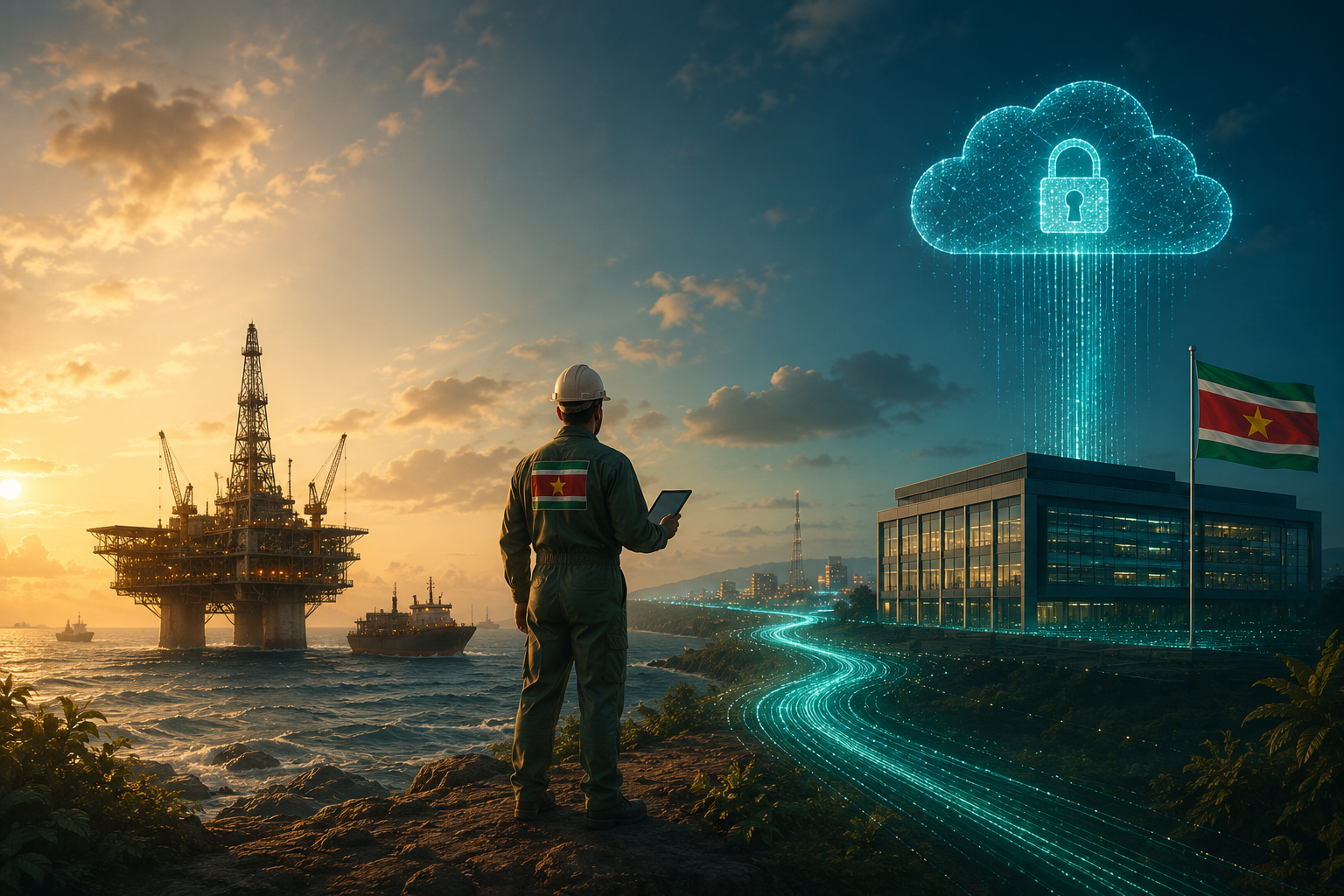
The capital is coming. The energy majors are here. And the entire national conversation has narrowed to a single question: how do we manage the oil? I want to argue that this is the wrong question — or at least, a dangerously incomplete one.
A windfall is not wealth. It is raw material. History is unkind to resource-rich nations that mistook the two, that let a boom wash through the economy and leave behind higher prices, a hollowed-out private sector, and a dependence deeper than the one they started with. The oil is not the prize. What we build with the proceeds is the prize. And the most valuable thing we can build is not another tower or another import-dependent service sector. It is sovereignty — the kind that compounds long after the wells run dry.
Let me be specific about what I mean, because "sovereignty" is the sort of word that dies of vagueness.
When international conglomerates arrive in a small economy, local firms face a binary choice. They can adapt their internal architecture to meet the rigorous compliance, reporting, and speed demands of the majors — or they can be relegated to low-value subcontracting, treated as risky partners, permanently downstream of the real value.
The legacy Caribbean firm — family-owned, centralized, run on intuition and informal networks — was sufficient for a slow economy. Against a global standard model that is procedural, data-driven, and relentless, it collapses under its own friction.
The conventional response is to tell local firms to "modernize" — to build the same heavy bureaucracy the multinationals run, only smaller. This is a fatal error. A small firm that mirrors a large firm's bureaucracy without its scale will simply die more slowly. We cannot afford the luxury of middle management.
I contend there is a third path, and it is the one available to us precisely because we are small and late.
The dominant assumption in international business is that developing nations suffer a "liability of origin" — that we lack the capital, the institutions, the infrastructure of the Global North, and must spend decades catching up.
In the age of artificial intelligence, I believe that assumption is inverted.
The primary liability of the modern firm is no longer a lack of resources. It is an excess of legacy architecture. A century-old European conglomerate carries thousands of middle managers whose entire job is moving information around, and decades of data trapped in incompatible systems. To become AI-native, it would have to dismantle itself — a political and financial impossibility. We carry none of that weight.
The periphery is not behind. In this specific moment, the periphery is the frontier.
Just as our region skipped landlines and went straight to mobile phones, our enterprises can skip the bureaucratic era entirely and move directly to AI-enabled autonomy. The next generation of globally competitive firms will not necessarily emerge from New York or London. They can emerge from Paramaribo — smaller in headcount, faster in adaptation, built from the start to compete asymmetrically.
Here is where the oil boom and the AI question converge, and where I believe Suriname holds a card almost no one has noticed.
The capital flowing into our basin is largely European. TotalEnergies is French. Shell has Dutch roots. These firms are bound by the world's strictest emerging rulebook for artificial intelligence and data — the EU AI Act and its data-protection regime — even when they operate far from Europe. They cannot, in good conscience or good compliance, hand sensitive operational data to opaque "black box" partners. They need partners who can prove transparency and protect data within a defensible legal jurisdiction.
For most of the world, that rulebook is a compliance headache. For us, it can be a product.
In the standard arrangement, a Surinamese firm uploads its most valuable data — geological, environmental, operational — to a foreign cloud. That data trains models we must then pay to rent back. The value accrues to the model's owner, never to the data's owner. This is extraction by another name, and it is the digital version of the very dynamic our oil sector must avoid.
The alternative is to keep the intelligence at home. By running AI on open systems within our own borders, a local firm retains the model itself — the weights, the learning, the compounding asset — and sells only the result, never the underlying data. We can position Suriname not merely as an oil exporter, but as a data haven: a jurisdiction where a European partner's information is arguably safer than it would be inside a hyperscaler subject to foreign surveillance law.
That is sovereignty you can sell. And unlike a barrel of oil, you can sell it twice.
None of this is theoretical for me. I have spent the last two years building it inside my own companies — proving that a firm in Suriname can run on an operating system that rivals global competitors in intelligence and speed, without the headcount, without the bureaucracy, and without surrendering its data to anyone. The architecture works. The harder question is whether we will build it as a nation, or let the moment pass.
Because the windfall will be spent either way. The only choice is whether it is spent on consumption that ends when the oil ends, or on capability that outlasts it.
A generation from now, no one will ask how many barrels we pumped. They will ask what we became while we had the chance.
We are not destined to be passive spectators in the global economy. We have the talent. We have the creativity. And now, for a narrow and precious window, we have the capital to build the architecture to lead. The oil is the beginning of the story. It must not be the end of it.
PhD, International Business & Artificial Intelligence
Founder & Chairman, K&K Heritage Group
Author of the CG POWER Method™
HCMS N.V. Insights
Category: Strategy & Sovereignty